|
|
 发表于 2009-1-14 09:37:40
|
显示全部楼层
发表于 2009-1-14 09:37:40
|
显示全部楼层
来自: 中国山东泰安
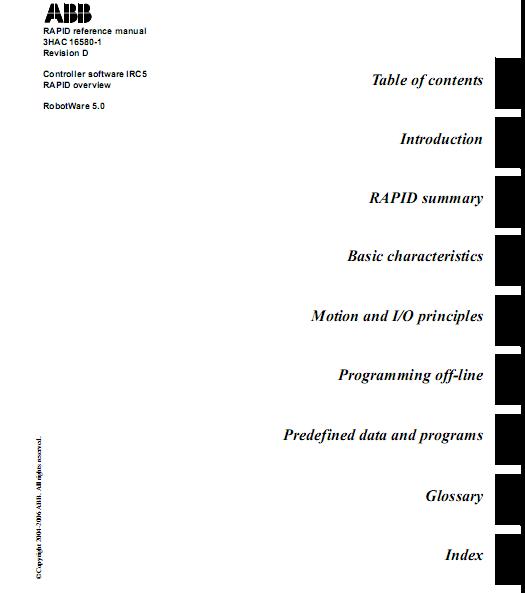
第四个文件:3HAC16580-1_revD_en_library.pdf* t5 W( S9 @+ M' B% _1 @9 q( q
1 M) I; w7 s4 W$ Q7 Y3 L# j; T
Contents
4 w) Y S- G( m0 N) m1 Introduction............................................................................................................................... 1. b5 v! u& h; d' F5 Y P+ c7 O
1.1 Other manuals................................................................................................................... 1
6 l* Y# D; E, ?" D' X1.2 How to read this manual ................................................................................................... 1
; W) S" o, [% i Typographic conventions ................................................................................................. 2
# `& l4 ?* g( `9 l0 A" Q8 A( x: M Syntax rules...................................................................................................................... 20 g' y; V1 V4 s x+ _1 X0 Z$ G0 }" ^
Formal syntax................................................................................................................... 3' U) c% f- c9 t* y: c
2 The structure of the language .................................................................................................. 5
. B" K5 X% y" p' x' `6 }6 ^. g) v3 Controlling the program flow .................................................................................................. 7( {! I& R. @7 e6 I6 l
3.1 Programming principles ................................................................................................... 7
- D C( T/ N4 M5 J4 y3.2 Calling another routine ..................................................................................................... 75 k1 ~& D, @9 _4 o) U* d
3.3 Program control within the routine................................................................................... 7
' u W$ L% \/ f# T& Q; d3.4 Stopping program execution............................................................................................. 82 K* \4 @, S+ D$ E. G( J
3.5 Stop current cycle ............................................................................................................. 8" x0 T' H3 a4 E+ y3 ~& \
4 Various instructions .................................................................................................................. 9) M4 x* I( Y3 V" o9 }! C
4.1 Assigning a value to data..................................................................................................9
$ R" ?) a+ G( O5 ^4.2 Wait................................................................................................................................... 9
4 Q0 `8 l# ^8 S1 F8 d5 J7 K4.3 Comments......................................................................................................................... 9
/ f" C# S% [; O$ e* w N( k& ]4.4 Loading program modules.............................................................................................. 10# p& x& g/ l' Z* o* ^) S j- o
4.5 Various functions ............................................................................................................ 10# q$ {. F v/ `$ Q* a, \. K7 O) z2 Q: \
4.6 Basic data........................................................................................................................ 100 }) |, ]8 P1 M! ?, @" I, k6 e$ u. _
4.7 Conversion function ....................................................................................................... 11
8 k2 F3 d$ d5 g9 W- i: R; F3 V5 Motion settings ........................................................................................................................ 13- I5 q3 r, d; r9 B; V
5.1 Programming principles ................................................................................................. 137 v( |7 E# m j; H3 J2 q, V
5.2 Maximum TCP speed ..................................................................................................... 130 O! A7 U; V% Q# P- T
5.3 Defining velocity ............................................................................................................ 14
# I- h1 V* @1 _. F5.4 Defining acceleration......................................................................................................14
5 j0 K' e# e$ h7 k& p U% M9 B5.5 Defining configuration management .............................................................................. 14; u M/ U# H$ H0 P3 Q
5.6 Defining the payload ...................................................................................................... 14) w% ?* v# y5 I, C5 X$ ]0 j
5.7 Defining the behaviour near singular points................................................................... 15
( c$ ^" M; B) H q5.8 Displacing a program...................................................................................................... 15
2 K# n1 ~+ B" T3 |( z5.9 Soft servo........................................................................................................................ 15
7 v9 D0 k5 U( L7 e6 M5 K0 i5.10 Adjust the robot tuning values...................................................................................... 16
4 i9 N8 W, Y4 ]. J7 e5.11 World Zones.................................................................................................................. 17) d1 V) f9 l" X) m6 X+ Y
5.12 Data for motion settings ............................................................................................... 17$ Z% B, e4 W1 A+ R* ~7 V
6 Motion ...................................................................................................................................... 19$ [: s z. r) c0 P' _7 s3 C& A
6.1 Programming principles ................................................................................................. 195 f8 s' d! R2 F2 }9 |2 ~0 r
6.2 Positioning instructions .................................................................................................. 20
/ [/ u' k2 N N0 A7 [8 _6.3 Searching ........................................................................................................................ 200 L6 i F8 M( y8 D0 i
II RAPID overview
. F. W" ?; K! T/ l, M6.4 Activating outputs or interrupts at specific positions ..................................................... 21
5 Q' {0 ^* v7 f1 l6.5 Control of analog output signal proportional to actual TCP .......................................... 21! t, |6 \, n9 b& B
6.6 Motion control if an error/interrupt takes place ............................................................. 225 W7 v; q6 Q$ R% k4 ~5 @+ Z
6.7 Get robot info in a MultiMove system........................................................................... 22
! k8 k. |5 p- I% `9 s6 l* k6.8 Controlling external axes................................................................................................ 23% p- b# V+ [, c8 |% V" F
6.9 Independent axes ............................................................................................................ 24
: d7 L/ C4 o! F# P0 v6.10 Path correction.............................................................................................................. 25' u) \5 v$ I) k. c& n( ^$ Q
6.11 Path Recorder ............................................................................................................... 25
: Q+ U: i9 O) k) _6 X& }6.12 Conveyor tracking ........................................................................................................ 26
& o* J/ |3 c% @( {0 K9 q& q, `6.13 Sensor synchronization................................................................................................. 26+ M1 e# _8 B1 e$ j
6.14 Load identification and collision detection .................................................................. 26, O, A) F O+ y& B) u& U) E
6.15 Position functions ......................................................................................................... 27% B7 P# K6 l2 a1 @5 d- Q
6.16 Check interrupted path after power failure................................................................... 274 |3 f/ [) ?! P' K" Z- X$ ]
6.17 Status functions ............................................................................................................ 27" `0 w: a: }( ]4 u# J1 n% f" L; a! O
6.18 Motion data................................................................................................................... 28) X7 r8 f! k/ [2 ~- J+ b5 E" {/ O! U
6.19 Basic data for movements ............................................................................................ 28
* V1 W0 f( K- P% i) \, M8 Q7 Input and output signals......................................................................................................... 29) m) o. p# h. w' ]/ O
7.1 Programming principles ................................................................................................. 29/ M" i R( M1 C/ }! e. |( D
7.2 Changing the value of a signal ....................................................................................... 29 m0 y6 [* {& m0 b: R7 Q3 d: L
7.3 Reading the value of an input signal .............................................................................. 29# ]+ c1 }2 ?8 J! I
7.4 Reading the value of an output signal ............................................................................ 30( B4 t8 \' @2 x) {
7.5 Testing input on output signals....................................................................................... 30
G- t3 m1 Q% E9 C+ z3 D7.6 Disabling and enabling I/O modules .............................................................................. 30
1 B: x C) R( P$ j7.7 Defining input and output signals .................................................................................. 31# D$ v( \4 J( {: p4 j8 C) _
7.8 Get status of I/O bus and unit ......................................................................................... 31$ } w! Y$ U3 s; z7 O# e
8 Communication....................................................................................................................... 33
/ c8 d, m/ x e" M" X8.1 Programming principles ................................................................................................. 33
0 R, w3 w' h$ P5 o2 e+ q: I+ e; b8.2 Communicating using the FlexPendant, function group TP .......................................... 33
) m$ R" C7 C2 V9 k1 d8.3 Communicating using the FlexPendant, function group UI........................................... 34
4 q* @1 {2 w" C+ Q8.4 Reading from or writing to a character-based serial channel/file................................... 35
1 l1 Y/ t. e5 Y7 q8 U* V8.5 Communicating using binary serial channels/files/field buses ...................................... 352 y- S5 u# }5 i: {9 E A) h
8.6 Communication using rawbytes ..................................................................................... 36
' z3 s6 A8 a4 ^! y; |# F8.7 Data for serial channels/files/field buses........................................................................ 37- n8 E7 r* s7 i' Y/ c
9 Interrupts................................................................................................................................. 39$ p6 `; |- G3 a6 O. ?, @
9.1 Programming principles ................................................................................................. 390 ^+ e2 _3 z5 d& G* F5 ^
9.2 Connecting interrupts to trap routines ............................................................................ 39: r# J, C' a6 U( Y+ X3 K" I
9.3 Ordering interrupts ......................................................................................................... 40' s& w( T. \; I3 J5 A- r/ W( V3 h
9.4 Cancelling interrupts..................................................................................................... 40
' B5 U- v7 F' N R, Z4 K......... |
-

-
|


 [复制链接]