|
|
马上注册,结识高手,享用更多资源,轻松玩转三维网社区。
您需要 登录 才可以下载或查看,没有帐号?注册

x
PDF格式、英文、图片文字资料。13页
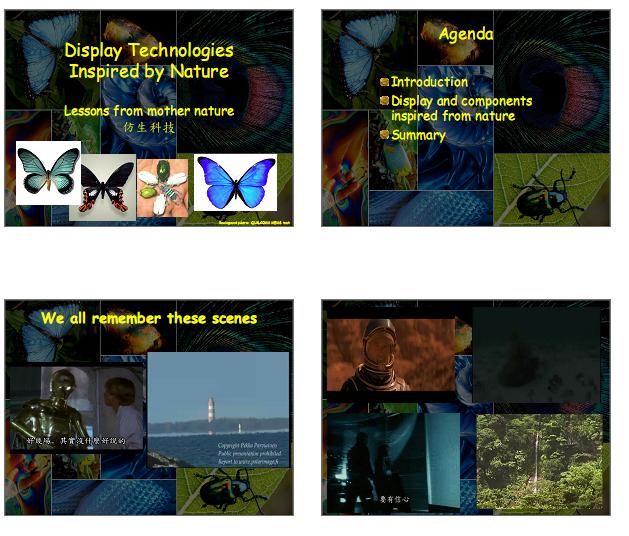
" x0 O9 P6 U, KDisplay Technologies 2 T3 z1 F( A, k& |
Inspired by Nature4 |6 I, Y0 Z& l9 O8 w3 T$ H! S
Lessons from mother nature4 d, E, g( ^1 N8 s
仿生科技, Y2 b4 e* R/ T; T
Background picture: QUALCOMMMEMS tech- z u" q* I7 \6 Q9 Y3 q
Agenda
9 @$ E' A7 Q# s! V1 yIntroduction6 {3 d4 h9 t9 R w& |
Display and components ( h5 f* H e6 \2 N
inspired from nature
4 g+ K% h4 C( `1 }* YSummary" ?( P* f/ s7 Q5 B! e" q* ?
We all remember these scenes
4 L' |0 V' ~3 z4 k& E- I# `1 z* rWhy are things colored
% C% J- S. K* ~9 R2 o8 i* U6 X6 [' ^Courtesy of Dr. R.O. Prum
& h8 ?7 D7 v1 Q+ g7 C0 s. NKurt Nassua, in his book The Physics and + t3 k8 z& O% N* b, C# C3 H, R
Chemistry of Color, identifies 15 6 k7 f. e: ?4 o; {
different causes of color! }" f! o/ U' I8 b. ^+ h+ Y
1. Incandescence3 \& i# l+ K) A* ?8 p
2. Gas Excitations
+ ?( Y) }: l0 }9 \, L3. Color from Vibrations and Rotations( Y% S# x. |1 H, x, J3 W. u
4. Transition Metals in a LigandField
% [* C9 ~! U5 f% K3 L( E5. Organic Molecules) u$ c% o6 r9 B$ i5 O* v0 a
6. Charge Transfer2 ^- x& c% W5 s! A
7. Metals! }, w! h, P- J2 R1 T# ]
8. Semiconductors: D: k& d8 L, W; I& j
9. Doped Semi-conductors
! B, H" _/ x7 r9 l$ @% {10. Color Centers
. k4 o/ G+ F* _" }11. Dispersive Refraction: X' d6 m( e$ x+ r2 c6 p
12. Polarization" X2 q1 Y% m6 y9 P
13. Scattering
" L7 z' a1 D$ ^4 _+ ]14. Interference
% U, J/ u) ^3 E- V15. Diffraction |
-
|







 发表于 2007-12-14 11:53:54
 楼主
楼主