|
|
马上注册,结识高手,享用更多资源,轻松玩转三维网社区。
您需要 登录 才可以下载或查看,没有帐号?注册

x
.
# C8 R4 B c$ C5 d" ]' ?Title Plastic Compression of a Pipe Assembly
, h' z$ h2 o: f& U
/ a( ^* E; o+ ]/ XOverview
4 y& A+ b* h# l }
6 O$ h6 W- k) ^| Reference: | S. H. Crandall, N. C. Dahl, An Introduction to the Mechanics of Solids, McGraw-Hill Book Co., Inc., New York, NY, 1959, pg. 180, ex. 5.1. | | Analysis Type(s): | Static, Plastic Analysis |
: h8 e" @, R6 a! kTest Case! e0 `; L& r) D$ G. G) S" b# v: U
2 J: P0 T# h h! |% p
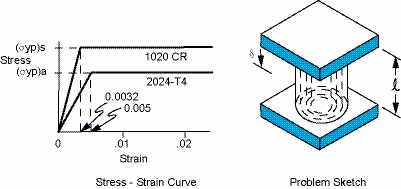
Two coaxial tubes, the inner one of 1020 CR steel and cross-sectional area As, and the outer one of 2024-T4 aluminum alloy and of area Aa, are compressed between heavy, flat end plates, as shown below. Determine the load-deflection curve of the assembly as it is compressed into the plastic region by an axial displacement. Assume that the end plates are so stiff that both tubes are shortened by exactly the same amount.' J: Y) H7 E. j# t
7 P2 V! f- A& Z8 f! }& M0 `Figure 7.1 Pipe Assembly Problem Sketch; B0 d+ g( Q/ m5 c1 ~7 V$ q V+ F$ c
+ }' J4 Q! D4 X; |. D' \! D* k3 _" e
 0 k4 t/ W% C! B% H/ I8 g3 s
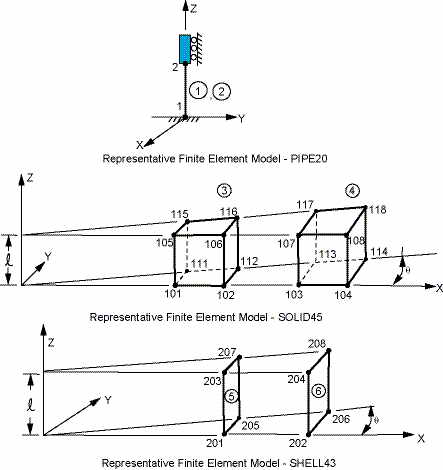
1 g+ I" t5 t0 MFigure 7.2 Pipe Assembly Finite Element Models; K# b$ b$ N. l& W9 c1 [- W) K
+ @/ p! `8 b3 K. _& j9 C( h1 H V
 ~% U+ J: g& g4 l) [
1 T) ~7 f+ z# ?4 I7 h: l! k| Material Properties | | Es = 26,875,000 psi | | σ(yp)s = 86,000 psi | | Ea = 11,000,000 psi | | σ(yp)a = 55,000 psi | | υ = 0.3 |
| | Geometric Properties | | L= 10 in | | As = 7 in2 | | Aa = 12 in2 |
| | Loading | | 1st Load Step: δ = 0.032 in | | 2nd Load Step: δ = 0.05 in | | 3rd Load Step: δ = 0.10 in |
|
& \1 v& G! F8 }5 C4 l" r
Analysis Assumptions and Modeling NotesThe following tube dimensions, which provide the desired cross-sectional areas, are arbitrarily chosen. Inner (steel) tube: inside radius = 1.9781692 in., wall thickness = 0.5 in. Outer (aluminum) tube: inside radius = 3.5697185 in., wall thickness = 0.5 in.2 I/ ~: A& f5 }5 j1 E. V+ C
/ ^$ d, A# F( m- f, `& b
The problem can be solved in one of three ways: 0 N( s3 H" T- w' i9 L% u. w! N9 y
0 u' j3 N* ?9 m- using PIPE20 - the plastic straight pipe element
- using SOLID45 - the 3-D structural solid element
- using SHELL43 - the 2-D plastic large strain shell element
3 T+ Z' [/ P3 n- c) u' F, I9 OIn the SOLID45 and SHELL43 cases, since the problem is axisymmetric, only a one element Θ-sector is modeled. A small angle Θ = 6° is arbitrarily chosen to reasonably approximate the circular boundary with straight sided elements. The nodes at the boundaries have the UX (radial) degree of freedom coupled. In the SHELL43 model, the nodes at the boundaries additionally have the ROTY degree of freedom coupled.
( |) d; ?* i1 R6 MAn ANSYS warning message is issued stating that element 1, (PIPE20 pipe element) has a radius to thickness ratio less than 5. Because the model involves only axial loading, this does not affect the accuracy of the results. 9 M# W3 ~7 F; u+ \3 p8 r
' x1 o( Y3 l! o# Z: B# eResults Comparison
7 t" n( B4 W1 G; R* R7 | | Target | ANSYS[1] | Ratio | | PIPE20 | Load, lb for Deflection = 0.032 in | 1,024,400 | 1,024,400 | 1.000 | | Load, lb for Deflection = 0.05 in | 1,262,000 | 1,262,000 | 1.000 | | Load, lb for Deflection = 0.1 in | 1,262,000 | 1,262,000 | 1.000 | | SOLID45 | Load, lb for Deflection = 0.032 in | 1,024,400 | 1,022,529 | 0.998 | | Load, lb for Deflection = 0.05 in | 1,262,000 | 1,259,695 | 0.998 | | Load, lb for Deflection = 0.1 in | 1,262,000 | 1,259,695 | 0.998 |
$ I. M( r& B; X8 ^/ s3 l
" Q& c& m0 t! ]. \8 k: Y- From POST1 FSUM of bottom nodal forces (ΣFZ).
| Target | ANSYS[1] | Ratio | | SHELL43 | Load, lb for Deflection = 0.032 in | 1,024,400 | 1,023,932 | 1.000 | | Load, lb for Deflection = 0.05 in | 1,262,000 | 1,261,423 | 1.000 | | Load, lb for Deflection = 0.1 in | 1,262,000 | 1,261,423 | 1.000 |
4 P+ \4 \0 S0 T4 S" A- Z- [
- From POST1 FSUM of bottom nodal forces (ΣFZ) X 360°/6°(Identified as parameter "LOAD").
|
|


 [复制链接]






 发表于 2007-11-9 15:22:36
 楼主
楼主